Showing posts with label French Revolution. Show all posts

Monday, October 26, 2026

French Counter Revolution- Chevaliers of the crown


Chevaliers of the Crown


Recently I was planning for some counter French Revolution troops to add to my collection predominantly cavalry. I came across an article in French about the Chevaliers of the Crown cavalry regiment. A member of the de Hercé family served with regiment after fleeing Mayenne in 1791, serving in the regiment when he was wounded in Holland in 1792. He then retired to bath where he died in 1795. 

The Count of Bussy traveled to Chambéry where the Count of Artois asked him, on June 1, 1791, to raise a body of men intended "for the defense of Religion and the Throne
" composed mainly of gentlemen and "bourgeois or town or country owners" drawn"mainly from the provinces of Dauphiné, Provence, Auvergne, Velay, Lyon and the surrounding areas"(Baron de Vitrolles). 

After going to Coblentz in September to the Brothers of the King to conclude the definitive organize the corps – which already had 150 to 160 volunteers – , on November 15, an order of creation establishing the corps and organization; the  "Dragon Knights of the Crown" claimed the same privileges as the Gendarmerie, so each rider had the rank of second lieutenant of the dragoons (confirmed on January 5, 1792). However, as several testimonies attest, including the Memoirs of the Duke of Enghien, who discovered the body in January 1792 in the States of Cardinal de Rohan, this formation, which had joined Condé's army at the end of November, was then designated as the "Bussy Legion or the Knights of the Crown"and was about 200 men strong; it was then increased to nearly 300, including 200 cavalrymen and a hundred infantrymen. Due to their insufficient number, the latter were reformed on May 1, 1792 to form a company of the noble infantry regiment on foot (Corsac company), while the two squadrons of the Knights-Dragons of the Crown were joined, in the Austrian formation of April 1793, to that of Dauphin within a half-division of the Noble Horse Regiment (3rd division, 1st major). 


The Count of Bussy and the Vidame de Vassé both had the rank of colonel at the head of these two units while the Viscount of Bussy, brother of the former, and M. d'Orville were first captains. The Marquis of Frotté was for a time among the Knights-Dragons of the Crown but he withdrew before the Alsace campaign to join Normandy and organize the counter-revolution there. 

From February 1794, the Count of Bussy undertook steps to raise a cavalry corps of 1300 to 1500 horses for the benefit of the Duke of Saxe-Teschen, general-in-chief of the German forces of the Empire, and these negotiations were to lead to the creation of the Royal and Imperial Regiment of Chasseurs de Bussy , raised for the King of Denmark in the name of his Duchy of Holstein. Few volunteers having wished to follow him, the Count of Bussy then sought to leave the army of Condé with his corps, which the prince fiercely opposed; in his Memoirs, he describes the Count of Bussy as 
"a very interested man, very ambitious, hated in his corps and who had obtained through his intrigues in Heidelberg the raising of part of the contingent of the Empire" 
 Finally, the regiment of the Knights-dragons of the Crown was disbanded in the summer of 1795 and immediately reconstituted under the name of Knights of the Crown.

Inspired by the uniform of the Lorraine dragoons in the 1786 regulations, that of the first Bourbon volunteers did not survive the adventure of 1790 and the corps experienced two successive ones: the first (1792-1795) was very close to the so-called Emigrants uniform (especially buttoned by a single row of buttons) but was distinguished by some features from that of the noble cavalry (button, pockets, equipment and armament, the noble riders not having rifles). If we suppose that the corps initially wore a uniform mentions a "hat in the ordinary form, decorated only with a gold braid and a waistcoat button (engraved in relief with a royal crown)" and wearing a white basin cockade. Grouvel deduced this from an illustration after the Restoration (Vernet) and from the fact that from the spring of 1792, the Knights-Dragons of the Crown adopted (like the legions of Mirabeau and Hohenlohe) a Austrian Rumford helmet during their stay in the states of the princes of Hohenlohe a model very well represented by Patrice Courcelle drawings below. 


Trumpeter 

Standard and finials 

Portrait of a member of the regiment 


Cheers
Matt

Saturday, September 12, 2026

National Garde du Nantes - Garde d'Honneur de Nantes

 National Garde du Nantes 

I am currently working on my French Revolution and Napoleonic’s this month and I am planning some National Garde units for fighting the Chouan and Vendee royalist rebellions. 

To my surprise I also found a National Garde du Nantes uniform for the 1808 visit of Napoleon and Josephine to the capital of Brittany. The city of Nantes and the region had still not recovered from the counter revolution fighting in the region from 1793 to 1795, and some chouan were still active in Brittany and Maine/Mayenne departments. 

The honor Garde was raised as a volunteer unit, uniforms were paid for partially by the members. It consisted of a two companies of 84 cavalry and two companies of 120 infantry and a band of 26 musicians. The city also presented two standards the unit, the Nantes Garde of honor was commanded by colonel Pitier Deurbroucq, who had lead the defence of the city in the Revolutionary wars.

Cavalry Uniform 

Black bicorne, white plume over an amaranth base, national cockade, gilt twisted braid edging, tassels, and gold buttons. Green Chasseur à Cheval-style coat with pointed lapels, collar, lapels, pointed cuffs, and amaranth turnbacks, gold buttons with an eagle bearing "Garde d'Honneur de Nantes" , gilt braided aiguillettes on the left shoulder, gold trefoils on the right shoulder, gilt hunting horns on the turnbacks. 
Officers wear the aiguillettes on the right and an epaulette of their rank on the left. The bicorne is edged in gold.
Ochre gloves. White waistcoat with three rows of gold buttons. White breeches with gold trefoils and braid. Black boots with gold trim and tassels. Sabre with copper gilt scabbard, gold sword knot, black belt and loops, gilt buckle. 
The officers also have a dress uniform with a coat whose lapels are green piped in amaranth, the rest as above. Undress uniform White cashmere breeches, white stockings, black shoes with gold buckles, small sword.

A hunting-style black leather horse harness with white metal buckles. The halter is trimmed with amaranth cloth, and it includes a black fly whisk, an amaranth surcingle, and a breastplate adorned with an eagle. The shabraque is made of dark green cloth, edged with amaranth cloth, with a gold lace braid running along the edge. It has gilt hunting horns in the corners, no portmanteau was fitted, pistols are holstered under the saddlecloth.

The trumpeters wear a uniform with the colors reversed, as was customary during the early part of the empire. 

Mounted Chasseur Officer 


Flag Finial

The mounted company drapeau


Uniform habit  of a OR

Original officers habit in the Nantes Museum 


Cuff and flap detail 

Turn back detail 

OR habit veste


Wednesday, November 12, 2025

French Revolution Drums…..

 I have decided to build my French Revolutionary Regiments for the Analogue Painting challenge this year, so research has fully commenced! While I was at the Musee de l’Armée a few weeks ago for the first time I have really looked at the revolution equipment so a number of photos were taken and the rest from all over the place bought together for my research. I do not think I will get to some of the detail but an indicator of what a drum looked like will suffice, the red white blue hoops, and white cords and an indication of a non brass background of some description I suspect! Enjoy another dive down the rabbit hole! 


Cheers

Matt


Sunday, September 1, 2024

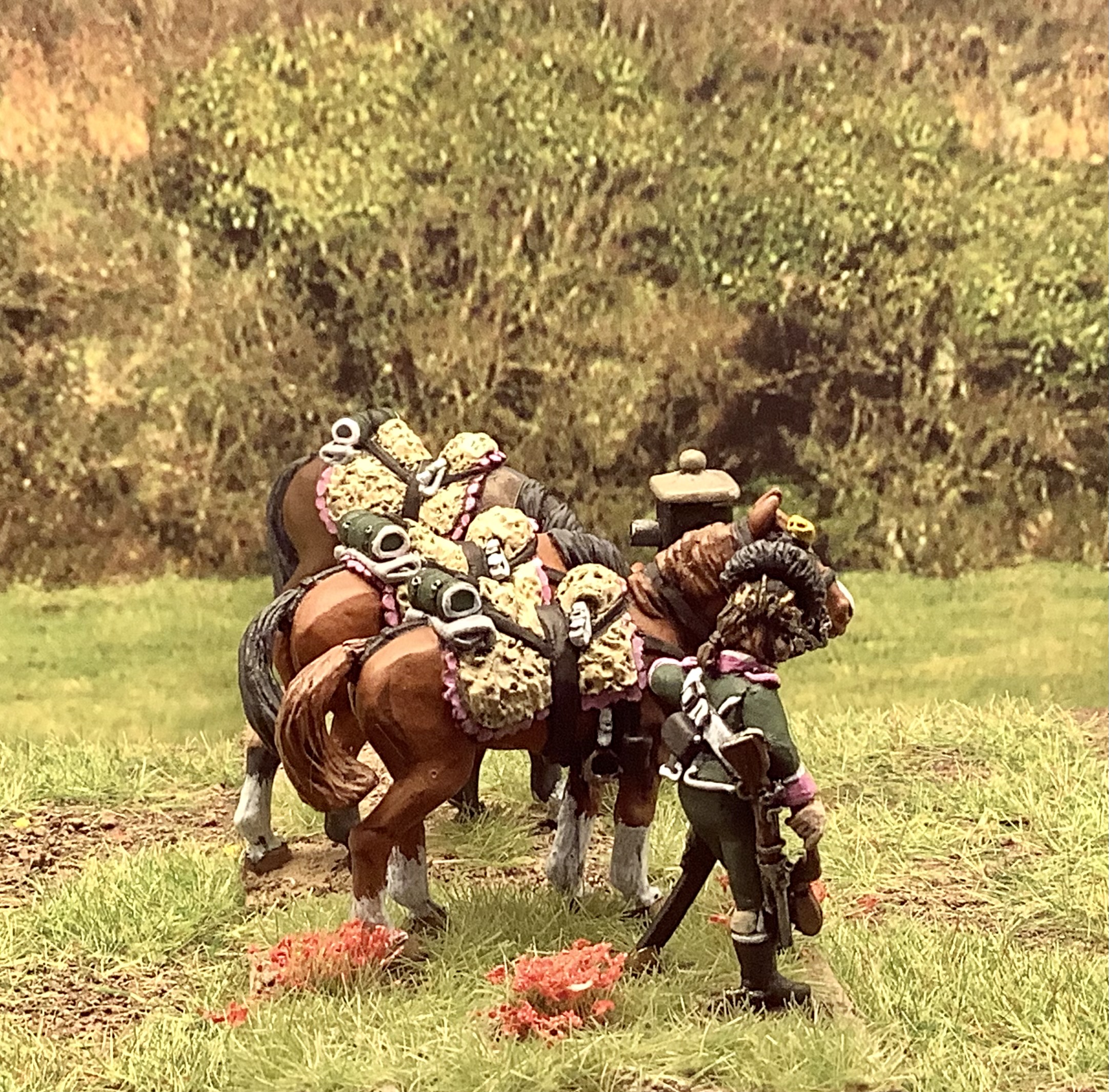
Chassuer watering horses

 Completed a 15th regiment chassuer watering horses for my French Revolution entry for August #OPC29 and build year #opcarmychallenge. Miniatures are from the Eureka miniatures range. 


Cheers

Matt


Thursday, August 8, 2024

Chouan Vendee artillery

 Vendee -Chouan Artillery 

Revolutionary armies - now Skytrex /Warlord 28mm artillery crew, guns Front Rank. 


These will join my Royal Catholic, Vendee and Chouan army for French Revolutionary wargames. In 1793 the Vendee Armee captured 50 pieces of artillery from the Saumur caserne, much though was very old some dating back to the mid 16th century. The remainder entered the army (22-28 pieces) After the defeat of the army at Cholet and the escape of the Vendean army across the Loire all of the captured guns were spiked and dumped into the Loire. 

Then during the move north west known as the great Galerne (gallop) into Maine (Mayenne) a number of 4 pounder and 8 pounders were captured at the battle of Entrammes from the Republican army. Upon arrival at Laval the cannon foundry was also raided where two seige mortars and a large 16lb 18th century gun from the chateau at Laval entered the armies arsenal. These guns were then used for the siege at Granville and at Dol de Bretagne, all of the guns were lost at the battle Le Mans and the retreat back to Mayenne.

I have elected to paint the pieces in the Vallèrie pattern blue colour and brass guns. 


Cheers

Matt

Wednesday, June 12, 2024

Vendee Project - part 4 Royal Catholic Armee Chouan Chevalier Cavalry

 Royal Catholic Armee Chouan Chevalier Cavalry

As parts of Maine were liberated by the Vendee army during 1793 a cavalry squadron was formed around North Maine and lower Normandy predominantly nobles. The unit was lead Le Général Henri Forestier, Commandant en second de la Cavalerie Vendéenn, the unit was small around 180 mounted men and around 40 dismounted owing to a horse shortage. They carried a holy banner with Mary from the monastery church at Avesnières. This banner was captured at Le Mans in December 1793.
 
Many of the men who survived the disaster at Le Mans fled to Normandy and Mayenne and then onto England via Jersey, those who did not joined General la Frotte and his Chouan army in lower Normandy and North Maine, some fighting until 1815. 

Some members also seemed to have served in the Les chevaliers de la couronne, as Jean-François -Simon de Hercé former deputy to the estates general, and company commander, a Hercé family member of the house we live in today attests to having fought in the battles in Flanders in 1792 then returned to Maine during the uprising, then fled to Bath in England, where he died in 1796.

The miniatures are 28mm from the Revolutionary Armies Range now sold by Skytrex and the horses are from foundry and crusader. The banner is from LBM Byzantine transfer cut down to size. I gave based them on single bases so they can be used for skirmish gaming. 
I have another squadron to complete for my Royal Catholic Armee but it will be in mixed uniforms of the Grenadiers and Bretons from the lower Vendee. 


Cheers
Matt   

Wednesday, March 20, 2024

Vendee / Chouannerie - French Revolution Project

 Vendee/Chouannerie Project 


This year as one of my major projects I want to complete my French Revolution Project and associated Royal Catholic Armee and French Revolution army. I have also been working on a ruleset at 1/10 figure scale over the last 5 years and hopefully will get it published later this year. 

I really want to fight five of  the battles from the great Galerne that are within 20 to 80klm of my French house and involved a number of our neighbors families and the Hercé family that lived in our house. Both the French and the Royal Catholic armies are quite small so it suits to reduce the representation factor of units and makes leaders for troop inspiration more important. 

Eventually by the end of the year I want to have a big enough army to replay a few of the local smaller battles and within two years the larger ones like Le Mans, Entrammes, Chateau Gontier,  and Dole Bretagne.  

My first units will be a few Revolution French and some of the royalist additions to Chouan collection.

Cheers
Matt

Thursday, June 8, 2023

VICTOIRES et CONQUÊTES des ARMÈES FRANCAISES 1792 - 1801 book review

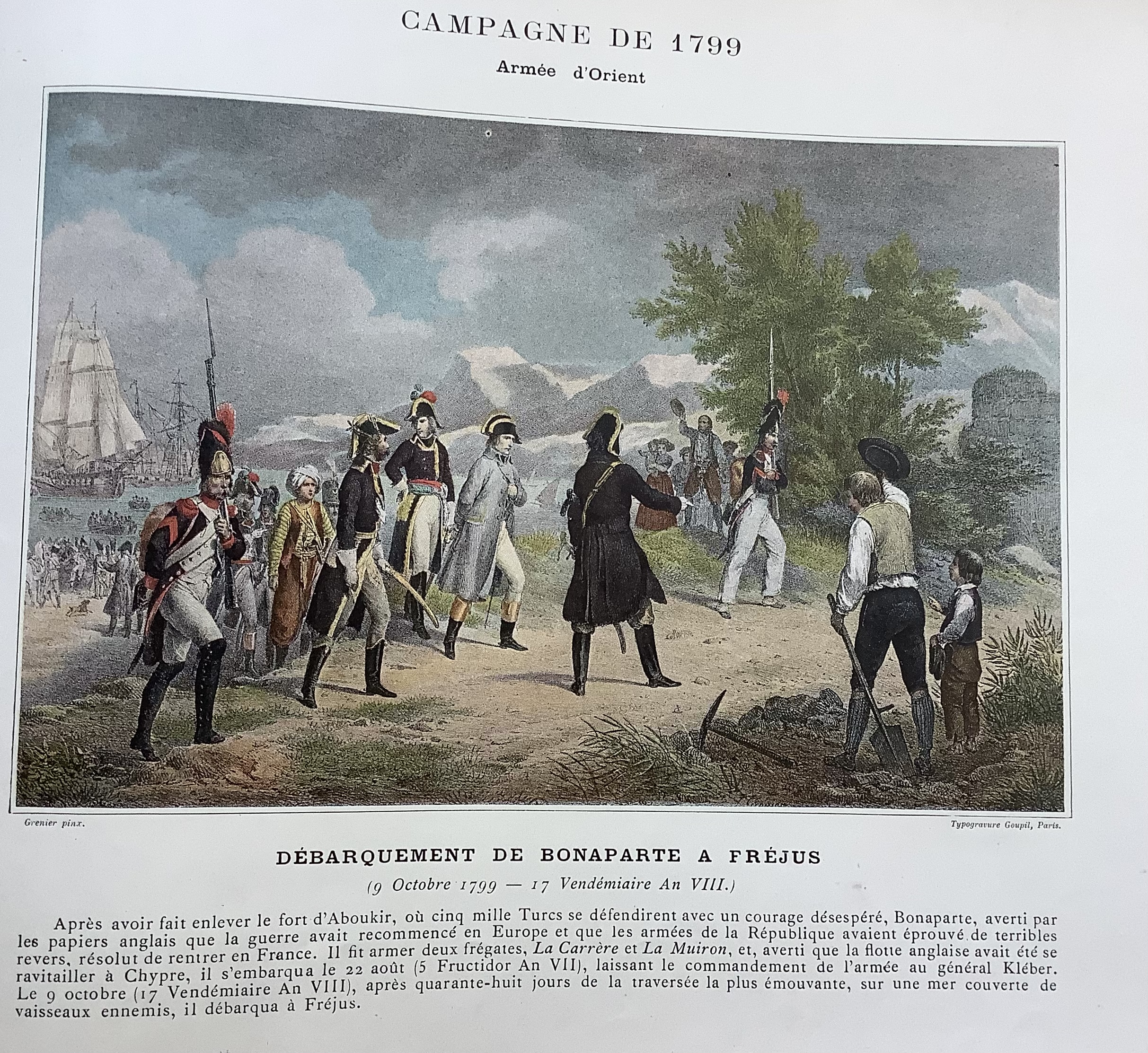
A fabulous pick up at a second hand book shop yesterday VICTOIRES et CONQUÊTES des ARMÈES FRANCAISES 1792 - 1801.


96 fabulous Revolutionary French army plates from various artists, some I have never seen before. Particularly some of the Ardennes and Italian campaign. Published in 1898 I think my copy is 1901. 


Cheers
Matt

Thursday, March 30, 2023

Marianne of the revolution

La guérison de Marianne

Another entry in the Analogue Painting  Challenge a foundry miniature of the Revolutionary Republican Marianne! 


Cheers
Matt

Tuesday, February 14, 2023

Terrain Tuesday - markers and mini Diorama

 First one for the year some table additions buildings and mini dioramas for scatter 

a foundry lady with a Mirliton donkey, love this!


Tankard turn marker, a gift from Philippe for Christmas, a nice resin piece made by a member of our club. 


Foundry medieval casualty markers


cheers
Matt


Saturday, June 12, 2021

2nd Regiment of Dragoons 1800-1812

 2e Régiment Dragons 

One of the oldest French Cavalry regiments in service formed in 1556. In January 1792 the ancien regime former Conde regiment was renumbered the 2e Régiment Dragons. The regiment fought a large number of engagements from the Revolution to empire. I have used Elite 28mm miniatures which make up a majority of my French Napoleonic cavalry 1800-1812 army, although Elite are getting long in the tooth, They do look good in big units. 

Yet to be presented their Eagle by the Emperor! 


Battles and engagements